
Syracuse Symposium Celebrates ‘Creativity’ with Renowned Quilters
Syracuse is a patchwork of stories, and many in the community recently came together to celebrate a common thread: an appreciation for quilting.
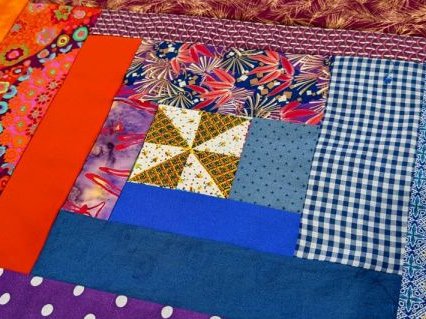
On March 21, Worldwide Quilting Day, the Humanities Center’s Syracuse Symposium on “Creativity” featured “Stitching Our Stories: Threads of Self, Community and Future,” welcoming three star-powered quilters — Valerie Goodwin, Chawne Kimber, and Thomas Knauer — to speak on their artistic journeys, work, and inspiration. This event was the culmination of four “sew-in” workshops hosted by a team of rotating facilitators since October, where participants designed quilt blocks centered on four distinct themes: person, place, community, and imagined futures.
Elizabeth Lance, Director of Research Development for the Social Sciences at Syracuse University, and one of the series’ four co-organizers, noted how the final event tied together thematic elements that attendees had been building on throughout the workshops.
“When we were thinking about how to celebrate the community that grew around these workshops, we thought: which artists out there in the quilting world can speak to these different themes?” Lance said. She explained how Goodwin’s quilts — specifically referencing her map quilts — were rooted in ‘place,’ while Kimber’s work was “reflective of her own identity,” speaking to the theme of person, and Knauer’s work, as a Central New Yorker, tied in aspects of local community.
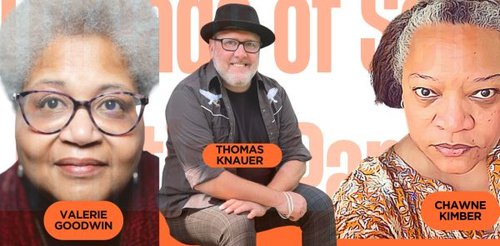
Each guest’s presentation added a unique piece on what an “imagined future” meant to them. In their distinct ways, Goodwin, Kimber, and Knauer’s work examined the way history, traditions, and current events inform the present moment — and how “looking forward” demands close attention to what has been, and what is actively unfolding, in the world today.
Here, quilting was shown as a form of connective tissue, not only binding people over a shared craft, but binding people to moments in time, history, and emotion.
Goodwin, whose work hangs in the International Quilt Museum, discussed the evolution of her fiber art and architectural quilts, showcasing two standout pieces, African Burial Grounds and Two Trails of Tears. Her work layers aerial views with symbolic figures, tracing how “place” holds memory, how geography is intertwined with inequality, and how physical terrain can carry pain that her quilts powerfully demand remembrance of.
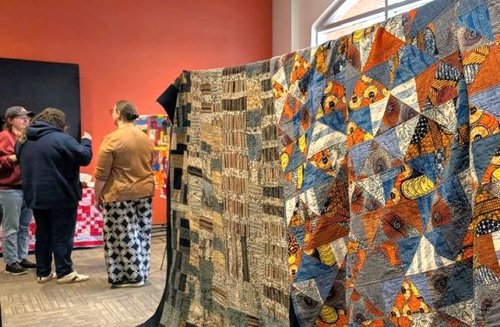
Audiences observed physical pieces that Knauer brought to the event, including colorful quilts with messages written in binary code. As Knauer put it, “I love the idea of text as texture.” Other quilts he shared communicated the “rage” that initially brought him to quilting, highlighting pieces that narrate devastating moments in time, such as the murder of Tamir Rice, and COVID-19’s rising death toll in 2020.
Kimber, whose work is held in the Smithsonian American Art Museum and Renwick Gallery, shared how her artistic journey started on a deeply familial level, creating her first quilt with some of the 400 ties she inherited from her late father. While Kimber’s early work is rooted in personal history, the presentation later shifted to more of her recent pieces on current events, including quilts that paid homage to Trayvon Martin and Eric Garner.
Often, quilting is not just about the finished product, but the process itself. Kimber, for example, shared how she typically plays music while making her quilts, but in her piece memorializing Eric Garner—where she threads the statement “I can’t breathe” 11 times—she quilted in silence to “feel the labor of those words.”
“It’s been really cool to hear about how they take current events and things that are meaningful to them and make them into quilts,” said Carter Smith, a former ESF student who attended Saturday’s event. “Chawne talked about how her quilts speak for her when she's unable to, and I thought that was really powerful.”
Smith attended the “sew-in” workshop focused on the “person” theme, where they selected fabrics and positioned them in ways that represented who they are. Smith’s quilt block was displayed at Saturday’s event, among the work of other participants.
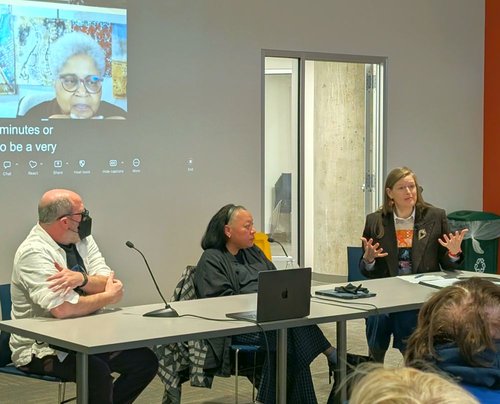
A panel discussion followed the guests’ presentations, with each speaker elaborating on how they embed meaning into their own work. Lance, who moderated the Q&A, guided the conversation through the themes of person, place, community and imagined futures, opening space for a more intimate exploration of the artists’ practices, and giving audiences a deeper understanding of what these ideas mean within their own lives.
“It was interesting to hear the different panelists’ responses on the ‘community’ question. I think that now, more than ever, community is one of the most important things in my life,” Lance said. “How do I find it? How do I cultivate it? How do I plug into it? For me, quilting has been a way to do that.”
Lance emphasized how the collaborative effort between herself and the three other organizers from Syracuse University — Rachel Ivy Clarke, associate professor at the School of Information Studies; Rochele Royster, assistant professor in Creative Arts Therapy in the College of Visual and Performing Arts; and Nicole Fonger, associate professor of Mathematics and Math Education (Arts and Sciences / School of Education) — made Saturday’s event and the workshops series what it was.
“Working with the group — my co-organizers — it's just a great example of ‘the whole is greater than the sum of the parts,’ because the experience that each one of us brought to this whole series made it that much greater,” said Lance.