
Artist Linda Infante Lyons Brings Alutiiq Storytelling and Art to Syracuse
Art has the power to traverse time, space, and culture. Though 4,000 miles separate Alaska and New York, the energy of Linda Infante Lyons’ artwork makes the distance feel fluid.
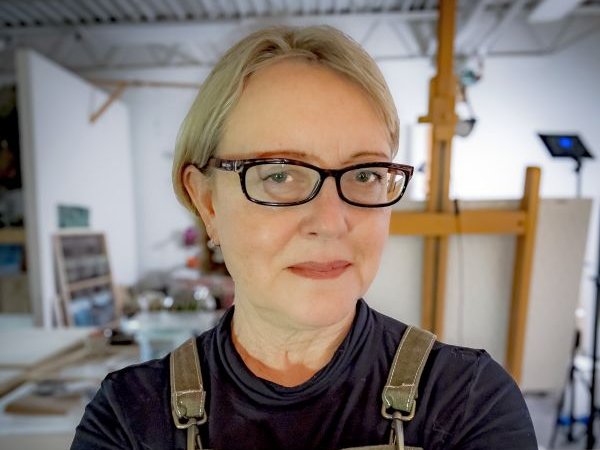
Linda Infante Lyons’ paintings line the walls of her studio in Anchorage, Alaska. From “icon portraits” to landscapes, her artwork holds a palpable verve — carrying a panorama of stories, ideas, and interpretations with them, often centered on Alutiiq culture and identity.
From April 6 to 17, Infante Lyons will bring her visual and academic storytelling to Syracuse University as the Humanities Center’s 2026 Jeannette K. Watson Distinguished Visiting Professor in the Humanities. Her two-week residency is organized around the theme of Visions of Resilience: Sacred Art & Storied Landscapes. Humanities Center Director Vivian May is excited about the many different ways Infante Lyons will engage the community through dialogs, lectures, and seminars focused on her art, Indigenous cultural resilience, approaches to environmentalism and environmental activism, storytelling, and more. Infante Lyons’ work, notes May, "immerses us in a sense of place and asks us to build relationships across boundaries. Infante Lyons visualizes the sacred, imagines the environment, and builds stories in ways that invite us to come together and imagine a more just future for all.”
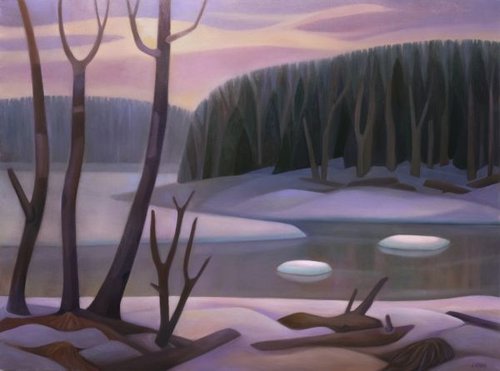
Infante Lyons, a painter and multimedia artist whose work engages themes of Indigenous sovereignty, cultural resilience, and environmental sustainability, was raised in Anchorage. After earning her B.A. from Whitman College, she studied at the Viña del Mar Escuela de Bellas Artes and spent 18 years in Chile. Her maternal family is from Kodiak Island—a large island in the Gulf of Alaska and the ancestral homeland of the Alutiiq/Sugpiaq people—where her grandparents were commercial salmon fishers. She is a registered Alutiiq Alaska Native and has tribal affiliation with the Alutiiq / Sugpiaq corporation, Koniag.
“I'm looking forward to conversations about learning from different cultures: the importance of a diverse mindset, the richness of looking at Indigenous cultures, how they see the world,” said Infante Lyons. Turning to the future, she asked: “And then, how can you apply that to a conversation [about] where we go forward? It could be applied to sustainability, or how we get along as human beings, or how we get along with the rest of the world.”
Notably, two new paintings by Infante Lyons will find a permanent home in the Syracuse University Art Museum. Melissa Yuen, curator at the museum, underscores how Linda’s icon portraits "invite interdisciplinary conversation, highlighting humanity’s relationship with the environment, disrupting Eurocentric worldviews, and celebrating the role women play in Alutiiq culture as connectors with the world.” In planning for the works to join SU's collection, Infante Lyons has had broad creative freedom, given the museum's desire to expand the voices represented in their collection and to "think more expansively about our environment and surrounding communities," Yuen explained. With the works under wraps until Infante Lyons’ residency, Yuen said she looks forward to "being surprised when the paintings arrive on campus!"
These as-yet unnamed pieces, to be unveiled on April 7, each depict Alaskan Native women dressed in kuspuks. The works incorporate traditional and contemporary Indigenous designs, and each woman cradles an animal central to Alutiiq culture: a seal pup in one painting, an otter in the other. The compositions echo a “Madonna and Child” style painting, complete with halos and other visual symbols of reverence.
Infante Lyons explained the historical weight behind choosing each animal. The seal pup conveys the significance of seals in Alutiiq life, not only for food and clothing, but as “companions and guides on the sea.” The otter also sustained and helped the Alutiiq people for thousands of years — until they became one of “the catalysts of the arrival of Russian colonization.” When Kodiak became a center of the Russian fur trade, for example, massive numbers of otters were decimated.
In portraying animals in the style of sacred Orthodox paintings and iconography, Infante Lyons emphasizes an intimate relationship between humans and the natural world -- one that opposes Western models of extraction and domination. Relatedly, some of her upcoming events on campus will highlight how Indigenous mindsets forge new pathways for understanding and caring for the environment.
“It’s a symbol of what Alutiiq culture would consider our kinship with animals. And it's not just animals: it's plants, it's the land, it's the air; all of the elements in our landscape are considered sacred, sentient. There's no hierarchy in our place in the world,” said Infante Lyons.
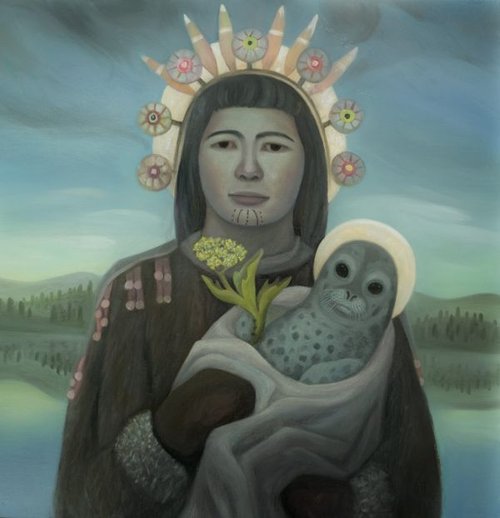
Chie Sakakibara, SU associate professor of Native American and Indigenous Studies and Geography and the Environment, described how when she came across one of Infante Lyons’ icon portraits, “St. Katherine of Karluk,” she was speechless.
“I was immediately struck by the work’s powerful expressivity, as Linda brings together multiple elements—ancestral presences and sacred, spiritual words—into the present, rather than relegating them to a past that no longer exists,” said Sakakibara.
In spearheading Infante Lyons’ upcoming residency Sakakibara invites the campus and broader Syracuse community into a shared encounter with Infante Lyons’ artistic wisdom. Sakakibara hopes the residency will spark some of the same kinds of connections she cultivates with students around traditional and land-based knowledge, cultural resilience, multi-species relations, and the continuity of Indigenous storytelling.
“I want my students to see how art, Linda's work and beyond, connects environmental identity and enhances the idea of storytelling. I want them to feel it, experience it, and recognize it,” said Sakakibara. “Linda's residency will offer a rare and invaluable opportunity to hear directly from an artist about the responsibilities, ethics, and relationships behind the work that shape and sustain her work.”
For co-host Timur Hammond, associate professor of Geography and the Environment, Infante Lyons’ residency opens up new points of academic connection, particularly for his Spring 2026 course, 'Geography of Memory,' and for strengthening his ongoing collaborations with the Engaged Humanities Network (EHN). One of EHN’s projects includes an Environmental Storytelling CNY learning guide, developed with Infante Lyons, to help spark discussion and activity in the classroom and community.
Hammond also looks forward to facilitating a virtual conversation about storytelling, art, and activism between Infante Lyons and geographer Emile Cameron. "Their respective projects both take the 'Arctic' as a key place of inspiration and imagination, and I'm hopeful that their conversation will open up new ways of thinking across the disciplines," Hammond said.
While Infante Lyons’ work carries many layers of meaning, her creative process begins without a preconceived agenda. Referencing SU creative writing professor and author George Saunders, Infante Lyons subscribes to the idea that “the muse finds you.” A blank canvas is an invitation for her to explore meaning, and to see her life experiences naturally flow out onto the canvas.
“You come to the studio, you start something, and you may try to have a concept or an idea or a composition, but that will change.” In being open to spontaneous inspiration during this creative process, “you end up with a better piece of artwork,” said Infante Lyons.
She hopes to inspire the same approach in those who come across her art. Her paintings — and the conversations that arise around them — need not uphold a rigid, absolute message. Rather, her work invites an opportunity for thought, exploration, and emotion.
All are welcome to meet Linda Infante Lyons and experience her work in person at an opening dialogue and reception at 4:30 p.m. Tuesday, April 7 in Eggers Hall and at other public events scheduled through April 16.